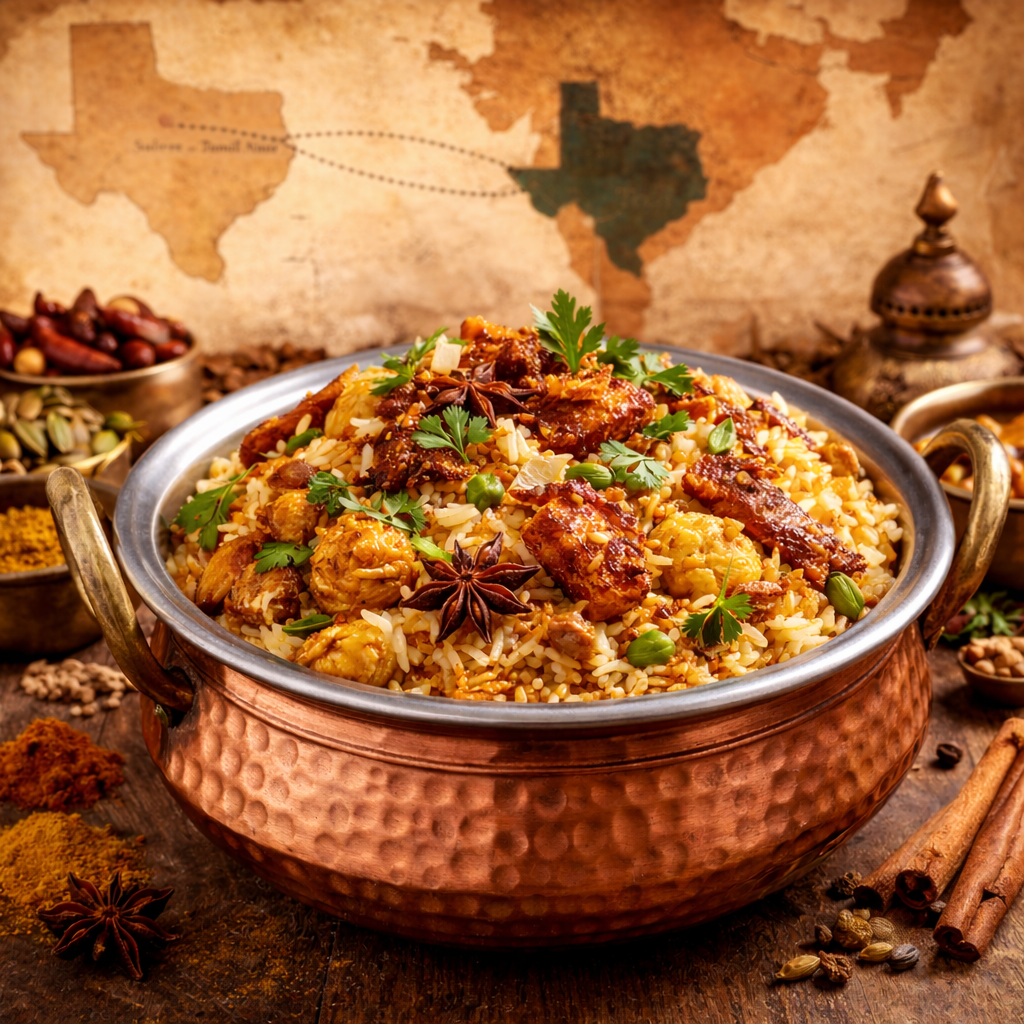
Close your eyes and imagine the aroma of firewood smoke drifting through a crowded Chennai street in the late 1980s. Steel vessels clink. Curry leaves crackle in hot oil. A young man, barely out of childhood, stands behind a modest roadside stall guarding a recipe that would one day cross oceans.
This is not just the story of a dish.
It is the story of resilience, reinvention, and regional pride.
It is the story of Salem RR Biryani.
Chapter 1: The ₹8,000 Beginning (1987)
Long before the brand name became recognizable, there was a 12-year-old boy named RR Tamil Selvan.
After losing his mother, he left his hometown and moved to Chennai. School ended early he dropped out in the 4th standard. Survival began.
He worked as:
- A hotel cleaner
- A server
- A daily-wage laborer
He lived frugally. Saved relentlessly. Invested in small chit funds. Every rupee counted.
By 1987, with just ₹8,000 (roughly $100 at the time), he took a leap of faith.
The First Stall
On Broadway in Chennai, he opened a small roadside stall selling:
- Chicken Biryani
- Chicken 65
The shop was originally named “Billal.” But professional rivalry and local competition forced a rebrand. That challenge became an opportunity.
He renamed it Salem RR Biryani:
- “Salem” — honoring his native roots
- “RR” — his own initials
What began as an 8-seat pavement operation slowly gained loyal customers not because of marketing, but because of flavor.
At the center of that flavor?
His mother’s recipe.
Chapter 2: Defining the “Salem Style”
Biryani in India is not a single dish; it’s a spectrum of regional identities. Salem style carved its own space within that spectrum.
So what makes Salem Biryani distinct?
1️⃣ The Grain: Seeraga Samba
While many biryani variations use long-grain basmati rice, traditional Salem style often features Seeraga Samba rice.
This short, aromatic grain:
- Absorbs spices intensely
- Holds moisture without becoming sticky
- Delivers compact, flavor-rich bites
The rice itself becomes part of the spice matrix rather than a carrier of surface flavor.
2️⃣ The Technique: Dum Cooking
Salem-style biryani relies heavily on the traditional dum method.
Dum cooking involves:
- Layering partially cooked rice and marinated meat
- Sealing the pot tightly
- Cooking over low heat (traditionally firewood)
- Allowing steam to circulate internally
This method ensures:
- Tender meat
- Separate rice grains
- Even spice distribution
- Deep aroma retention
The result is structured flavor, not greasy heaviness.
3️⃣ The “Mother’s” Recipe
The brand’s identity is inseparable from Tamil Selvan’s mother’s original recipe.
Even as the business grew into an empire of over 25 outlets in India, the core masala foundation remained unchanged.
It was refined but never diluted.
That consistency built trust.
Chapter 3: From 8 Seats to an Empire
By the late 1990s, the once-humble stall had evolved into a recognizable name across Chennai.
The journey from:
- Pavement stall
- To a structured dine-in outlet
- To a multi-location brand
Was driven by one principle: protect the recipe.
Even as expansion occurred, the family maintained strict quality control. Though franchise opportunities emerged, adherence to traditional cooking methods remained mandatory.
The “No-Franchise Philosophy” in spirit meant:
- No shortcut cooking
- No excessive oil adjustments for market trends
- No ingredient substitutions
- No compromise on dum technique
This discipline preserved authenticity through scale.
Chapter 4: The Journey to Texas (2025)
The leap across continents was not accidental.
By 2025, the Indian diaspora in the United States, especially in Texas, had grown significantly. The Dallas-Fort Worth metroplex became a hub for South Indian families.
The brand made its U.S. debut in August 2025.
Plano, Texas — The First Step
The first American location opened in Plano at 6832 Coit Rd.
Plano quickly became more than a restaurant location; it became a community anchor. The restaurant partnered with local vendors like Shri Foods during festivals such as Diwali, reinforcing cultural continuity.
Expansion to McKinney
In October 2025, a second branch opened in McKinney at 1411 N Custer Rd, under the ownership of Vinoth Kumar.
Salem RR Biryani
The McKinney location extended the brand’s reach deeper into suburban Texas, bringing Salem’s flavors into a new demographic landscape.
Chapter 5: Why Texas?
Texas was not a random choice.
1️⃣ Cultural Bridge
The DFW metroplex hosts a large South Indian community. Many residents grew up with Salem-style biryani but lacked access to it abroad.
Salem RR Biryani became a culinary time machine.
Menu items like:
- Mutta Kalaki (soft-cooked eggs)
- Kaadai (Quail) 65
- Mutton Keema
Are rarely found in mainstream Indian-American restaurants.
Bringing them to Texas filled a cultural gap.
2️⃣ The “Military Hotel” Vibe
In Tamil Nadu, “Military Hotels” are famous for rustic, non-vegetarian feasts.
The Texas branches replicated that style:
- Bold appetizers
- High-protein offerings
- Rustic flavor profiles
- Firewood-inspired dum technique
In a suburban American setting, this created a rare fusion of environment and authenticity.
3️⃣ Halal Assurance
All meat served in the Texas locations is 100% Halal an important detail for the local Muslim community.
This reinforced inclusivity without compromising tradition.
Chapter 6: Firewood Flavor in a Modern Kitchen
One of the most remarkable aspects of the Texas expansion is the effort to replicate traditional firewood flavor profiles.
While health regulations and infrastructure differ from Chennai roadside stalls, the cooking philosophy remains consistent.
The process includes:
- Large sealed vessels
- Heavy-lid dum cooking
- Slow heat distribution
- Strict spice ratios
This ensures the biryani in Texas carries the same aromatic intensity that defined its origins.
Consistency across continents is not easy.
It requires discipline.
Chapter 7: From Chennai Pavement to Texas Suburbs
Contrast the scenes:
1987, Broadway, Chennai
A roadside stall. A young man cooking over open flame. Eight seats. Steel plates.
2025, Plano & McKinney, Texas
Modern dining rooms. Community gatherings. Festival celebrations. Structured kitchens.
The setting has changed.
The recipe has not.
The transition from dust-lined pavements to climate-controlled suburban storefronts represents more than growthit represents preservation across distance.
Cultural Impact in Texas
Salem RR Biryani in Texas functions as:
- A festival gathering space during Pongal and Deepavali
- A community meet-up point
- A nostalgia bridge for first-generation immigrants
- A discovery point for second-generation families
It is not just serving food it is maintaining continuity.
The brand proves that diaspora dining does not have to mean adaptation through dilution.
Authenticity can travel.
Frequently Asked Questions
Who founded Salem RR Biryani?
Salem RR Biryani was founded by RR Tamil Selvan, who began with a roadside stall in Chennai in 1987 using his mother’s recipe.
What makes Salem Biryani different?
It uses Seeraga Samba rice and traditional dum cooking, preserving layered spice integration and structured texture.
When did Salem RR Biryani open in Texas?
The first U.S. location opened in Plano in August 2025, followed by McKinney in October 2025.
Is the Texas branch authentic?
Yes. The Texas locations maintain traditional cooking methods and follow strict quality control standards aligned with the original brand philosophy.
Conclusion
From a single roadside stall on a Chennai pavement to the bustling dining rooms of Plano and McKinney, the story of Salem RR Biryani is more than just a business expansion; it’s a triumph of heritage over distance. It is a testament to the fact that a mother’s secret recipe, crafted with grit and an ₹8,000 dream, can cross oceans without losing its soul.
Today, as the aroma of slow-cooked firewood biryani wafts through the Texas air, it serves as a delicious reminder to the diaspora that no matter how far you travel, the authentic taste of home is only a plate away. At Salem RR, you aren’t just ordering a meal; you’re tasting a 35-year legacy of resilience, spice, and spirit.